SHARE


LIXIL’s Shower Toilet Technology Honored with IEEE Milestone

Japanese Innovation Turns Utilitarian Ceramic Fixture into Sophisticated Appliance that Transforms Personal Hygiene
TOKYO — LIXIL Corporation (“LIXIL”, TSE Code: 5938), maker of pioneering water and housing products, announced that its “Sanitarina 61”—Japan's first domestic shower toilet launched in 1967—has been recognized with the prestigious “IEEE Milestone” designation, joining global breakthroughs such as Edison's electric lighting system, the compact disc and Wi-Fi. The designation also jointly recognizes Toyo Toki (now TOTO Ltd.) and Matsushita Electric Industrial Co., Ltd. (now Panasonic Housing Solutions Co., Ltd.), for their contribution to electric bidet toilet technology in Japan. The recognition by the Institute of Electrical and Electronics Engineers (IEEE) highlights how LIXIL’s ongoing commitment to human-centric engineering and innovation has been fundamental in transforming daily bathroom routines worldwide.
Pioneering Human-Centric Engineering
LIXIL’s journey in shower toilets began in 1964 with a challenge to create an entirely new standard for personal hygiene in Japan. At a time when no anatomical or behavioral data existed for such devices, engineers at Ina Seito, one of LIXIL’s core heritage companies, conducted thousands of meticulous practical evaluations using clay and plaster. Through these evaluations, the team determined the optimal nozzle location, water pressure, and a spray angle of approximately 75 degrees that balanced effective cleansing with nozzle cleanliness, while also devising multi-layer thermal controls to eliminate burn risks entirely. This transformed a utilitarian fixture into a sophisticated appliance, rooted in LIXIL's approach to innovation. Over half a century later, it continues to evolve in today's advanced toilet solutions, including the "SATIS X" series.
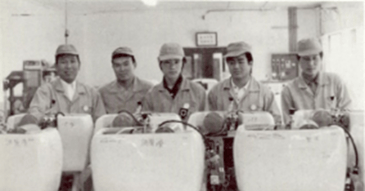
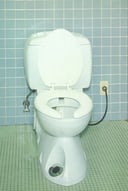
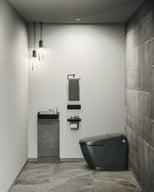
(From left) Early development team of the shower toilet; "Sanitarina 61" launched in 1967; the latest "SATIS X"
Scaling Japanese Innovation Through Global Brands
LIXIL has been expanding its shower toilet technology beyond Japan to redefine daily bathroom routines across international markets. Through its global brand portfolio, including American Standard, GROHE, and INAX, LIXIL has been adapting its human-centric engineering to meet regional cultures, preferences, and infrastructure needs. A prime example is the GROHE Sensia Series, which brings together INAX’s pioneering Japanese shower toilet technology with GROHE’s award-winning German design and engineering, creating a distinctive combination of advanced hygiene, personal comfort, and contemporary aesthetics worldwide. 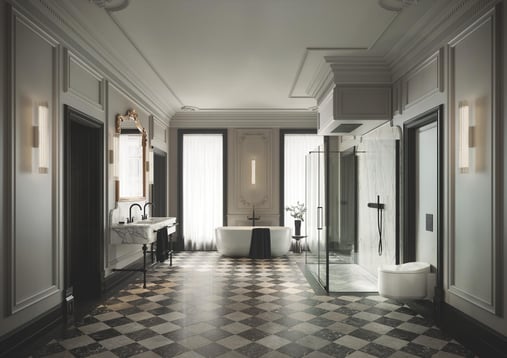
GROHE Sensia Arena
Hiroyuki Onishi, Executive Officer of LIXIL Water Technology Japan, commented:
“The IEEE Milestone recognition is an immense honor for LIXIL and a testament to an ongoing commitment to innovation, which has been driven not only by our own journey since ‘Sanitarina 61’ in 1967, but by the collective achievements of Japan’s sanitaryware industry. From the outset, our focus was never merely on creating a convenient sanitary fixture, but on delivering meaningful value that nurtures personal well-being and enriches the bathroom space. What began as a Japanese innovation is now redefining daily wellness and hygiene practices around the world. As a pioneer, LIXIL remains dedicated to advancing this technology to make better homes a reality for everyone, everywhere.”
Key Innovations Driving Global Differentiation
To deliver on its commitment to daily wellness across diverse international markets, LIXIL has been incorporating key technological advancements across its global portfolio of bathroom products:
- From User Insights to Inclusive Innovation:
The technological evolution of shower toilets is fundamentally a history of inclusive innovation. In 1981, responding to feedback from female users, LIXIL introduced Japan’s first dedicated feminine-wash function, later incorporating a dual-nozzle system to separate rear-wash and feminine-wash nozzles and address cross-contamination concerns. In addition, LIXIL’s innovations extend to accessibility features such as automated lids that eliminate the need for users to bend over, easing physical strain for seniors and those with mobility challenges. Today, this Inclusive design remains a core feature across LIXIL’s global product offerings to meet diverse hygiene expectations. - Aqua Ceramic Technology:
LIXIL’s proprietary ceramic technology features super-hydrophilic performance that prevents waste and limescale buildup from adhering to the bowl. Designed to maintain its shine through simple daily cleaning, Aqua Ceramic ensures long-lasting cleanliness across LIXIL’s global product lineup.
About IEEE:
IEEE is the world’s largest technical professional organization and is a public charity dedicated to advancing technology for the benefit of humanity. Through its highly cited publications, conferences, technology standards, and professional and educational activities, IEEE is a trusted voice across fields ranging from global standards, aerospace systems, computers, and telecommunications to biomedical engineering, electric power, and consumer electronics. Learn more at https://www.ieee.org.
Appendix: IEEE Milestone Citation
Title: Pioneering Electric Bidet Toilets, 1967-1979
In 1967, Ina Seito introduced the Sanitarina 61, an electric bidet toilet engineered for Japanese users through anthropometric measurements and user-centered engineering. Significant subsequent electric bidets included TOTO's Wash-Air Seat, which introduced an electrically controlled heated seat, in 1969, and Matsushita Electric's DL-80 with electronic control in 1979. Each of these popular innovations improved personal hygiene, enhanced quality of life, and transformed sanitation technology in Japan.
SHARE